Attention Is All You Need
Paper: Attention Is All You Need
Authors: Vaswani et al. (Google Brain, 2017)
Overview
The paper introduces the Transformer architecture — a model based entirely on attention mechanisms, dispensing with recurrence and convolutions.
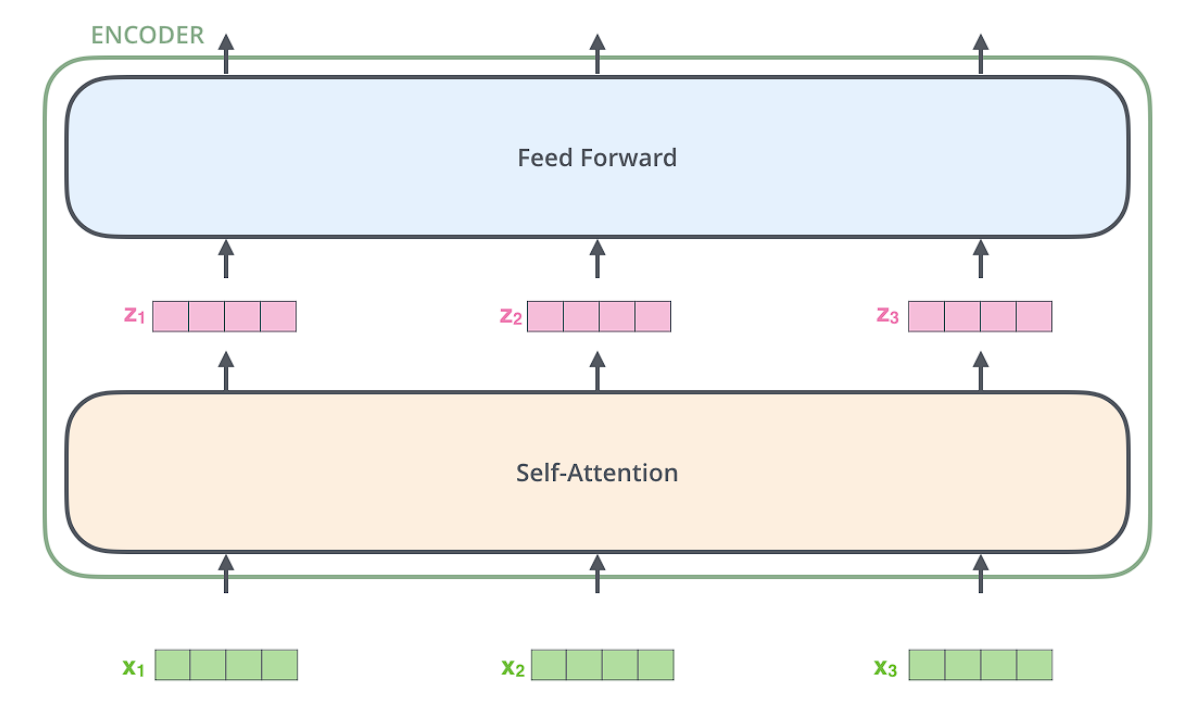 ENCODER
An encoder receives a list of vectors as input. It processes this list by passing these vectors into a ‘self-attention’ layer, then into a feed-forward neural network, then sends out the output upwards to the next encoder.
Self attention
As the model processes each word (each position in the input sequence), self attention allows it to look at other positions in the input sequence for clues that can help lead to a better encoding for this word.
Calculating self-attention using vectors
Step 1 : For each word, we create a Query vector, a Key vector, and a Value vector. These vectors are created by multiplying the embedding by three matrices (Wq, Wk, Wv) that we trained during the training process.
Note: Wq, Wk, Wv are learned parameters — they start randomly initialized and are optimized during training. When using pretrained models like BERT or GPT, these matrices come pre-trained.
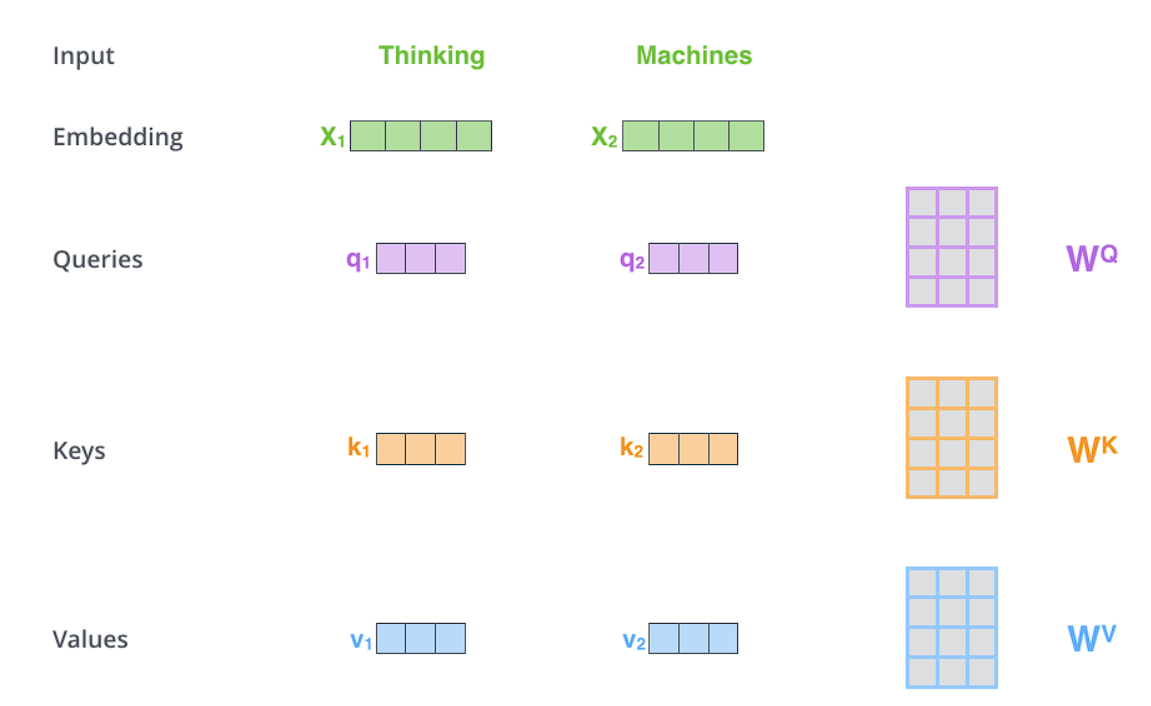 These new vectors are smaller in dimension than the embedding vector. Their dimensionality is 64, while the embedding and encoder input/output vectors have dimensionality of 512.
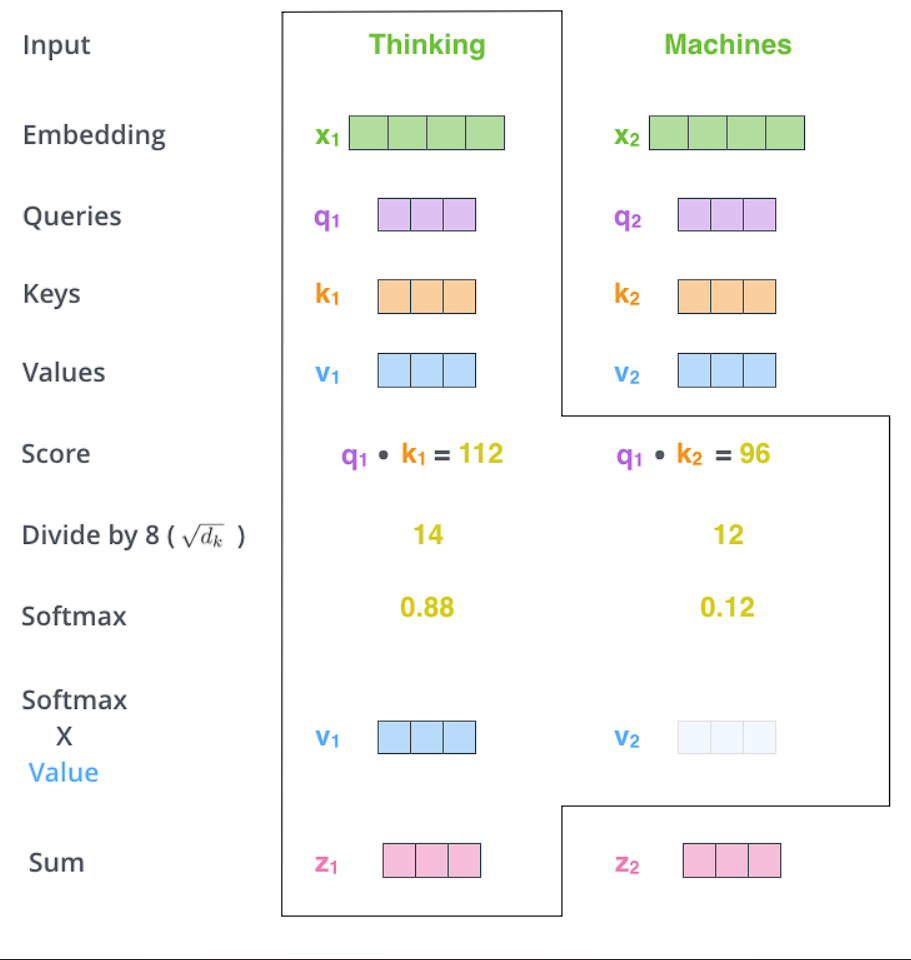
Step 2 : To calculate a score. The score determines how much focus to place on other parts of the input sentence as we encode a word at a certain position.
The score is calculated by taking the dot product of the query vector with the key vector of the respective word we’re scoring. So if we’re processing the self-attention for the word in position #1, the first score would be the dot product of q1 and k1. The second score would be the dot product of q1 and k2.
Step 3 : Divide the scores by the square root of the dimension of the key vectors used (√dₖ). This leads to having more stable gradients.
Why √dₖ? For large dₖ, dot products can grow very large in magnitude, pushing the softmax function into regions where it has extremely small gradients (saturated). This makes training difficult. Scaling by √dₖ keeps the values in a reasonable range.
Step 4 : Pass the result from Step 3 through a softmax operation. Softmax normalizes the scores so they’re all positive and add up to 1.
Step 5 : Multiply each value vector by the softmax score. The intuition here is to keep intact the values of the word(s) we want to focus on, and drown-out irrelevant words (by multiplying them by tiny numbers like 0.001).
Step 6 : Sum up the weighted value vectors. This produces the output of the self-attention layer at this position
Matrix Form: The steps above show single-word calculation for clarity. In practice, we compute attention for all words simultaneously using matrix multiplication — the Q, K, V matrices contain all query/key/value vectors stacked together, making it highly parallelizable on GPUs.
The entire self-attention calculation can be summarized by this equation:
The matrix multiplication by V performs the weighted sum
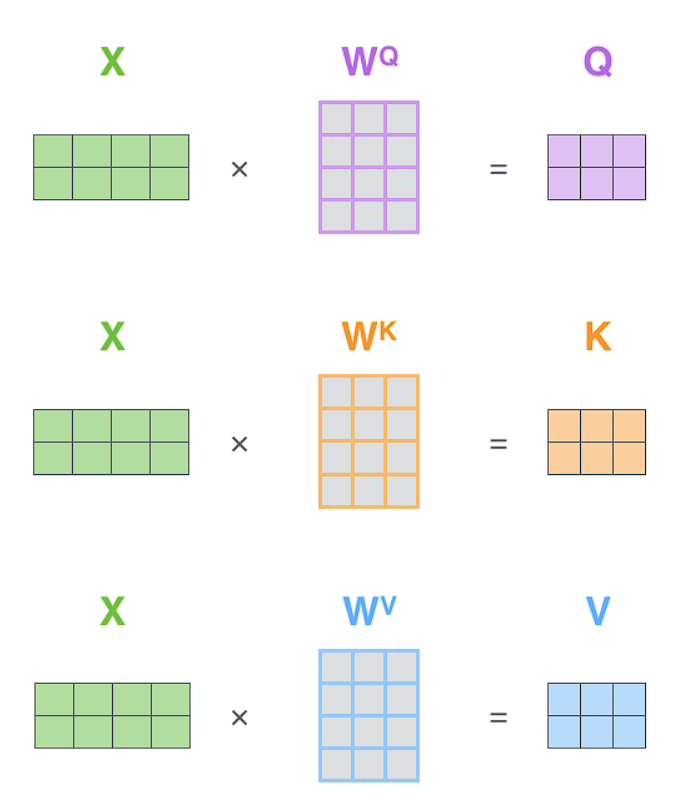
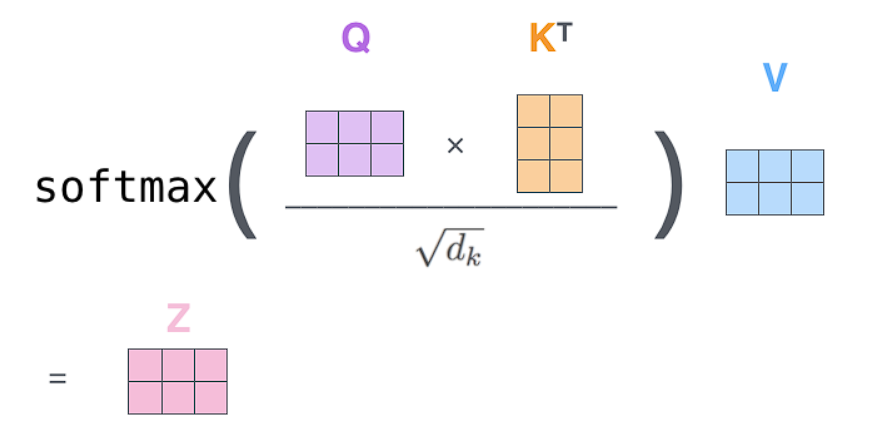
Let:
Score matrix:
Attention weights (the “attention matrix”):
Softmax is applied row-wise (over the keys for each query), so each row sums to 1:
Final attention output:
Example: Self-Attention for “Hello World”
import math

# Step 0: Simple embeddings for "Hello" and "World" (2 words, 4 dimensions each)
X = [
    [1.0, 0.0, 1.0, 0.0],  # "Hello" embedding
    [0.0, 1.0, 0.0, 1.0],  # "World" embedding
]

# Weight matrices Wq, Wk, Wv (4x3 - projecting from 4 dims to 3 dims)
Wq = [[0.1, 0.2, 0.3], [0.4, 0.5, 0.6], [0.7, 0.8, 0.9], [0.1, 0.2, 0.3]]
Wk = [[0.2, 0.3, 0.4], [0.5, 0.6, 0.7], [0.8, 0.9, 0.1], [0.2, 0.3, 0.4]]
Wv = [[0.3, 0.4, 0.5], [0.6, 0.7, 0.8], [0.9, 0.1, 0.2], [0.3, 0.4, 0.5]]

def matmul(A, B):
    return [[sum(a * b for a, b in zip(row, col)) for col in zip(*B)] for row in A]

def transpose(M):
    return [list(row) for row in zip(*M)]

def softmax(row):
    exp_row = [math.exp(x) for x in row]
    total = sum(exp_row)
    return [x / total for x in exp_row]

# Step 1: Compute Q, K, V
Q = matmul(X, Wq)  # [2x4] @ [4x3] = [2x3]
K = matmul(X, Wk)
V = matmul(X, Wv)

print("Q (Queries):", Q)
print("K (Keys):", K)
print("V (Values):", V)

# Step 2: Compute scores = Q @ K^T
K_T = transpose(K)
scores = matmul(Q, K_T)  # [2x3] @ [3x2] = [2x2]
print("\nScores (Q @ K^T):", scores)

# Step 3: Scale by sqrt(d_k)
d_k = len(K[0])  # dimension of keys = 3
scaled_scores = [[s / math.sqrt(d_k) for s in row] for row in scores]
print("Scaled scores:", scaled_scores)

# Step 4: Apply softmax (row-wise)
attention_weights = [softmax(row) for row in scaled_scores]
print("Attention weights:", attention_weights)

# Step 5 & 6: Multiply by V to get output
output = matmul(attention_weights, V)  # [2x2] @ [2x3] = [2x3]
print("\nFinal output Z:", output)
Output:
Q (Queries): [[0.8, 1.0, 1.2], [0.5, 0.7, 0.9]]
K (Keys): [[1.0, 1.2, 0.5], [0.7, 0.9, 1.1]]
V (Values): [[1.2, 0.5, 0.7], [0.9, 1.1, 1.3]]

Scores (Q @ K^T): [[1.4, 1.58], [1.04, 1.18]]
Scaled scores: [[0.808, 0.912], [0.600, 0.681]]
Attention weights: [[0.474, 0.526], [0.480, 0.520]]

"Hello"'s new representation is 47% itself + 53% "World"

Final output Z: [[1.042, 0.785, 0.985], [1.044, 0.788, 0.988]]

Z[0] = [1.042,  0.785,  0.985]
         ↓        ↓       ↓
       dim1     dim2    dim3

Examples of what dimensions MIGHT encode:
- Noun-ness vs Verb-ness
- Positive vs Negative sentiment
- Concrete vs Abstract
Multi-headed attention
Expands the model’s ability to focus on different positions.
We have multiple sets of Query/Key/Value weight matrices (the Transformer uses eight attention heads, so we end up with eight sets for each encoder/decoder). Each of these sets is randomly initialized. Then, after training, each set is used to project the input embeddings (or vectors from lower encoders/decoders) into a different representation subspace.
import torch
import torch.nn as nn
import math
class SelfAttention(nn.Module):
    def __init__(self, embed_size, heads):
        super().__init__()
        self.embed_size = embed_size
        self.heads = heads
        self.head_dim = embed_size // heads

        self.queries = nn.Linear(embed_size, embed_size)
        self.keys = nn.Linear(embed_size, embed_size)
        self.values = nn.Linear(embed_size, embed_size)
        self.fc_out = nn.Linear(embed_size, embed_size)

    def forward(self, x):
        N, seq_len, _ = x.shape

        # Linear projections
        Q = self.queries(x)
        K = self.keys(x)
        V = self.values(x)

        # Split into multiple heads
        Q = Q.view(N, seq_len, self.heads, self.head_dim)
        K = K.view(N, seq_len, self.heads, self.head_dim)
        V = V.view(N, seq_len, self.heads, self.head_dim)

        # Scaled dot-product attention
        scores = torch.einsum("nqhd,nkhd->nhqk", Q, K) / math.sqrt(self.head_dim)
        attention = torch.softmax(scores, dim=-1)
        out = torch.einsum("nhqk,nkhd->nqhd", attention, V)

        # Concat heads and project
        out = out.reshape(N, seq_len, self.embed_size)
        return self.fc_out(out)
class TransformerEncoder(nn.Module):
    def __init__(self, embed_size, heads, ff_hidden, dropout=0.1):
        super().__init__()
        self.attention = SelfAttention(embed_size, heads)
        self.norm1 = nn.LayerNorm(embed_size)
        self.norm2 = nn.LayerNorm(embed_size)

        self.feed_forward = nn.Sequential(
            nn.Linear(embed_size, ff_hidden),
            nn.ReLU(),
            nn.Linear(ff_hidden, embed_size)
        )
        self.dropout = nn.Dropout(dropout)

    def forward(self, x):
        # Self-attention + residual connection
        attention = self.attention(x)
        x = self.norm1(x + self.dropout(attention))

        # Feed-forward + residual connection
        forward = self.feed_forward(x)
        x = self.norm2(x + self.dropout(forward))
        return x

# Example usage
encoder = TransformerEncoder(embed_size=512, heads=8, ff_hidden=2048)
x = torch.randn(1, 10, 512)  # batch=1, seq_len=10, embed=512
output = encoder(x)
print(output.shape)  # torch.Size([1, 10, 512])
Positional Encoding
To account for the order of the words in the input sequence, the transformer adds a vector to each input embedding. These vectors follow a specific pattern that the model learns, which helps it determine the position of each word, or the distance between different words in the sequence.
Architecture Diagram
Input → Embedding + Positional Encoding → Encoder (×6) → Decoder (×6) → Output
Key Equations
Scaled Dot-Product Attention
Multi-Head Attention
References
- Original Paper: https://arxiv.org/abs/1706.03762
- The Illustrated Transformer: https://jalammar.github.io/illustrated-transformer/